

Global Innovation in Mission-Critical Communications
ETHERSTACK PLC. (ESK.ASX)
Introduction. Etherstack Plc (ASX:ESK) is a mission-critical communications technology company that develops and licenses software and systems enabling secure, mission-critical push-to-talk (MCPTT) voice and data for public safety, defence, utilities, transportation and critical infrastructure. ESK sits at the intersection of legacy Land Mobile Radio (LMR) networks and next-generation 4G/5G mission-critical services, positioning the company as a key enabler of the global transition to broadband-enabled critical communications.
Major Contract Wins Strengthening Recurring Revenue. ESK has secured major customer wins that validate its technology, including a 7-year AT&T master supply agreement with minimum US$2.5m p.a. and a £14.2m (~A$30m) five-year UK Home Office contract. These contracts meaningfully expand ESK’s high-margin support revenue. This improves recurring revenue generation and overall revenue stability, while funding continued investment in the IWF growth platform and global expansion into additional OECD markets.
Compelling Intrinsic Upside. Using a DCF, we estimate ESK’s fair value at A$1.09 per share, implying ~78% upside. Revenue is forecast to grow at a 33% CAGR from FY25 to FY30, underpinned by CaaS, with EBITDA margins expanding as operating leverage materialises. Notably, our forecasts exclude new contract wins beyond those already secured, suggesting meaningful upside optionality to our base case.
Read our equity research report on Etherstack by clicking the Equity Research button below.
EQUITY RESEARCH ETHERSTACK WEBSITE

KEY INVESTMENT INSIGHTS
Scalable Business Model
Etherstack operates a capital-light, high-margin licensing model that enables global scalability without significant incremental costs. Its core offerings – software protocol stacks and mission-critical network solutions – can be deployed to new customers (or via partner channels) with minimal additional R&D or infrastructure spend. This scalability is evident in Etherstack’s partnerships with major carriers, where the company’s technology can serve nationwide user bases without Etherstack having to build out physical networks. As a result, the business can rapidly grow revenues by leveraging existing intellectual property and a “develop-once, deploy globally” approach, leading to strong operating leverage. The FY25 result provided a compelling demonstration of this dynamic: revenue increased 70% while operating expenses (excluding D&A) grew by only 11.1%, driving a US$3.2m EBITDA turnaround. The company’s recent introduction of Communications-as-a-Service and the steady growth in recurring support fees further highlight a scalable revenue base that can expand as client deployments increase.
Clear Business Strategy
Etherstack has a focused strategy centred on bridging legacy radio networks with next-generation broadband communications for mission-critical users. The company targets well-defined segments – public safety agencies, defence, utilities, transportation and resource industries – where reliable push-to-talk voice is indispensable. By providing interoperability between traditional LMR systems and 4G/5G networks, Etherstack offers a clear value proposition: it enables governments and enterprises to upgrade to advanced broadband services without abandoning their existing radio infrastructure. Go-to-market execution is equally clear-cut, combining direct contracts with government and enterprise clients with strategic partnerships. This multi-channel approach accelerates adoption across target markets and has been validated by a series of high-profile deals, underscoring that Etherstack’s strategy is resonating in its chosen domains.
High Barriers To Entry
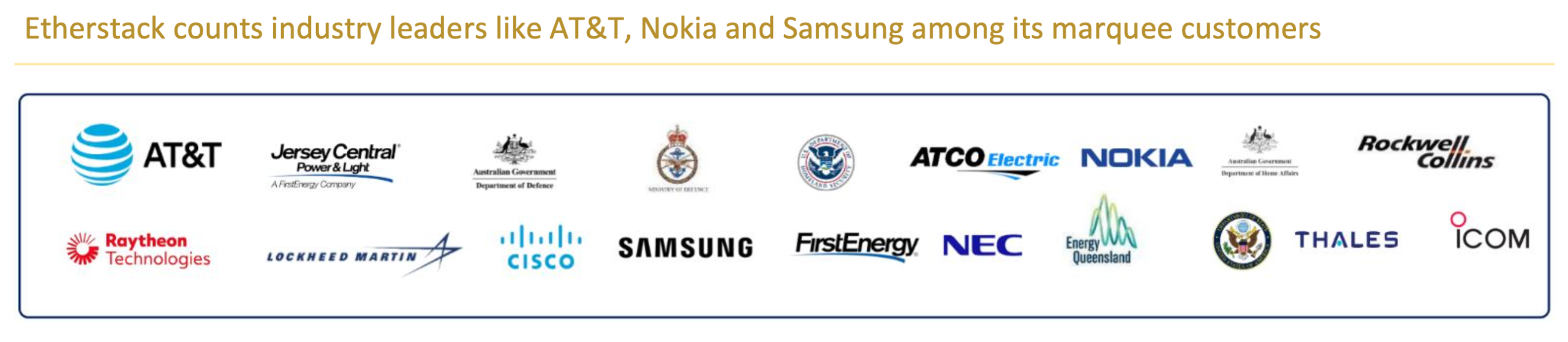
Etherstack’s competitive moat in mission-critical communications is reinforced by significant internal IP and external industry barriers that new entrants would struggle to overcome. Over two decades, the company has invested over US$36 million in developing proprietary digital radio technologies and has built a reputation as a leading licensor of LMR protocols worldwide. In fact, Etherstack’s technology is found in almost every major brand of LMR equipment, reflecting deep integration into the industry’s value chain. This entrenched position is protected by the strict requirements of the sector, where any competitor must achieve compliance with complex standards (APCO P25, TETRA, DMR, 3GPP MCX, etc.), obtain regulatory certifications, and prove absolute reliability in life-and-death communication scenarios. Moreover, clients in public safety and defence are highly risk-averse, favouring established vendors with proven track records. Etherstack’s long-term deployments and reference projects with top-tier customers, such as AT&T and the UK Home Office, make it the incumbent of choice, raising switching costs for would-be challengers. Lengthy sales cycles and procurement processes (often several years from tender to contract) further tilt the playing field toward incumbents. Collectively, the company’s specialised know-how, extensive IP, long-standing customer relationships, and the industry’s structural hurdles create high barriers to entry that safeguard Etherstack’s market position.
Near-Term Cash Flow and Profitability
Etherstack is approaching a critical inflection point in its financial trajectory. After years of investing in its IP platform and absorbing the cash flow volatility inherent in early-stage government contracts, the company is now on the cusp of sustained profitability and meaningful free cash flow generation. FY25 marked a decisive turning point: EBITDA swung to a US$2.0m profit from a US$1.2m loss in FY24, and operating cash flow tripled to US$3.2m. With the recently announced Australian Government contract providing incremental revenue upside to management’s prior FY26 guidance, operating leverage is set to accelerate as largely fixed operating costs are spread across a materially larger revenue base. We forecast EBITDA margins to expand to 21.5% in FY26E and 25.0% in FY27E, with FCFF turning sustainably positive from FY28E as the current elevated IP investment cycle matures. Critically, the nature of Etherstack’s revenue is becoming increasingly contractual and recurring, with CaaS and support revenues projected to contribute a growing share of the top line. This visibility, combined with the company’s eighth consecutive year of positive operating cash flow in FY25, gives us confidence that the path to self-sustaining profitability is not only credible but underway.
Successful Management
Etherstack is led by an experienced and highly aligned management team with a demonstrated track record in the wireless communications arena. Founder and CEO David Deacon has over 30 years of industry experience – he started Etherstack in 2002 and has since grown it into a global operation with deployments across North America, Europe, and Asia-Pacific. Under his stewardship, the company has developed pioneering technologies (such as the world’s first LMR-LTE interworking solution) and forged partnerships with industry giants. Supporting David is a seasoned board and executive group: Peter Stephens, the Chairman, is a veteran venture capitalist who has guided multiple technology companies to success; co-founder Paul Barnes (Director) and CFO Adam Hoey bring strong financial acumen and have been with Etherstack since its early years, ensuring stability and prudent capital management. Additionally, the team benefits from domain experts like Scott Minehane, a telecom strategy and spectrum specialist. This depth of expertise and continuity within the leadership has translated into consistent execution, evidenced by major contract wins in competitive tenders, and innovation that stays ahead of industry trends. Insiders also own a significant share of the company (the CEO alone holds ~34%), aligning management’s incentives with shareholder interests. Overall, Etherstack’s management has both the domain expertise and the commitment to continue driving the company’s growth and delivering on its strategic vision.
Significant Investment Upside
Our DCF analysis yields an intrinsic value of A$1.09 per share, implying ~78% upside from the current share price. Notably, we believe this estimate is conservative for several reasons. First, our revenue projections are anchored to contracts already in hand and do not incorporate any new contract wins, despite ESK currently tendering for multiple opportunities across LMR, MCX, and defence segments. Second, management’s view that up to 200 national or regional carriers may ultimately adopt IWF technology implies a total addressable market far larger than what is captured in our model, which is principally driven by the AT&T and UK Home Office deployments. Third, our terminal growth rate of 3.5% is modest relative to the projected ~11% CAGR for the MCPTT market through 2028. We view ESK as offering a compelling risk/reward profile, underpinned by secured contractual revenue growth, expanding margins, and embedded optionality from new contract wins and international market expansion.
PRODUCT AND TECHNOLOGY
Product Overview
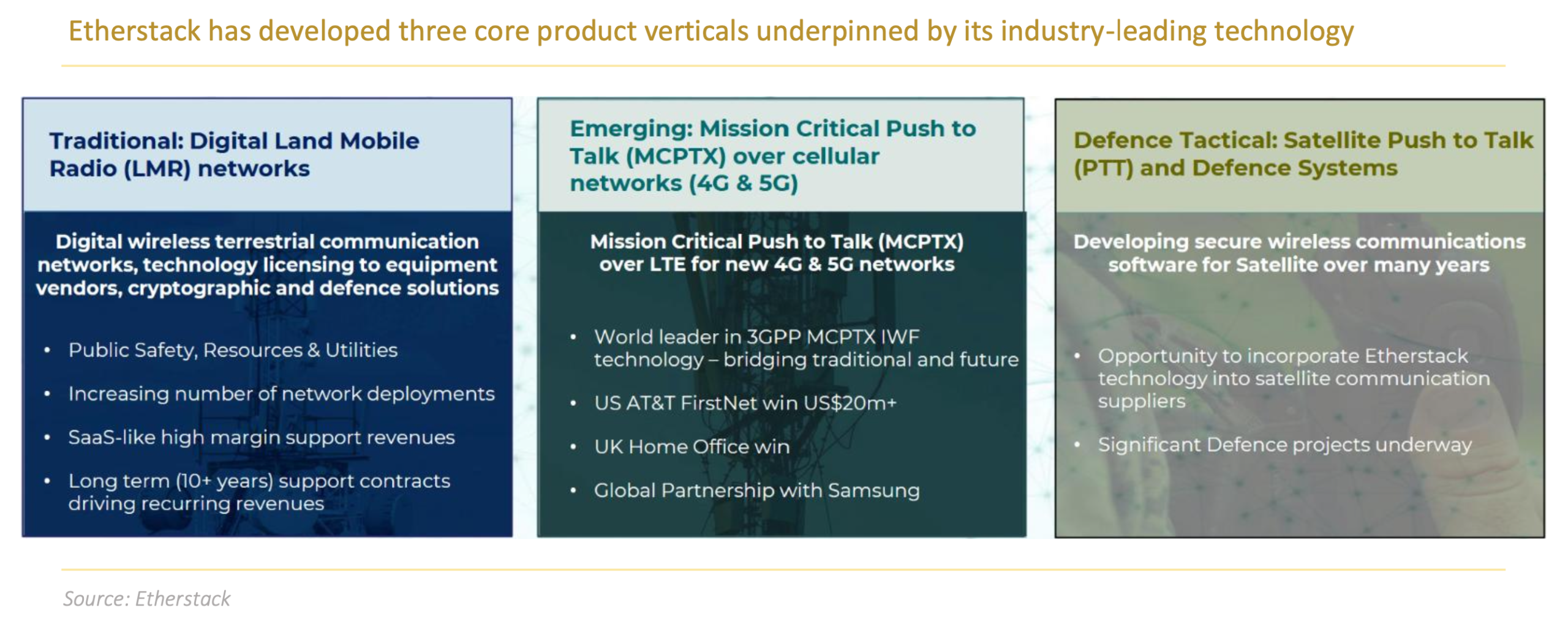
Etherstack’s product portfolio is purpose-built for the mission-critical communications market, where mission critical agencies and industrial operators require assured availability, secure voice communications, and increasingly, seamless interoperability between legacy LMR networks and next-generation broadband (LTE/5G) services. The company’s strategy is to monetise this transition through a layered offering: a cash-generative LMR foundation embedded across global OEM ecosystems, complemented by higher-growth interworking and MCX solutions that enable a pragmatic migration path for customers who cannot “rip and replace” incumbent radio infrastructure. With field-proven deployments, standards-compliant software, and a growing base of recurring support revenue underpinning reinvestment, Etherstack is positioned as a critical enabler of the global shift toward hybrid, interoperable public safety and industrial communications architectures.
Digital LMR Networks
Embedded at the Foundation of Global Digital Radio Ecosystems. Traditional digital two-way radio networks (LMR) remain a cornerstone of Etherstack’s business. The company supplies digital LMR infrastructure and software compatible with all major international standards, including APCO P25, TETRA, and DMR, which are used by police, emergency services, military, utilities and industrial fleets globally. Etherstack’s protocol stack technology is widely embedded in the LMR ecosystem, with management noting that >70% of global LMR radio manufacturers license component parts of Etherstack LMR protocol technology. This diverse customer base and deep OEM integration position Etherstack as a critical behind-the-scenes enabler of mission-critical radio interoperability. It is a key differentiator for Etherstack as a world-leading LMR domain expert and is essential to the successful deployment of its IWF product, particularly in multi-OEM end-user environments.
High-Availability Voice Under Harsh Conditions. Digital LMR remains the benchmark for resilient, low-latency, instant push-to-talk voice, particularly in environments where cellular coverage is unreliable or during disaster scenarios. Etherstack’s LMR networks are engineered for coverage, robustness, and operational continuity, supporting mission-critical use cases across public safety and industrial operations. Digital modulation and error correction provide improved audio intelligibility at the edge of coverage versus analog systems, supporting reliable communications in remote, rugged, and high-interference environments.
Security and Mission-Critical Feature Set as a Core Differentiator. Security and operational control are central to Etherstack’s LMR proposition. Etherstack’s LMR systems support advanced encryption, Over-the-Air Rekeying (OTAR), and mission-critical operational features such as group/individual calling, emergency signalling, call prioritisation, text messaging, and GPS location reporting. These features are critical in multi-agency scenarios where secure interoperability and robust command-and-control workflows are non-negotiable.
MCX Interworking Function (IWF) – LMR/LTE Bridge
The “No-Disruption” Migration Layer for Public Safety Modernisation. Etherstack’s MCX IWF is designed to solve the central problem facing public safety and critical infrastructure agencies globally: LMR networks cannot be switched off overnight, yet broadband (LTE/5G) is increasingly required for richer services. The IWF acts as the operational bridge that allows legacy LMR users to communicate seamlessly with MCPTT users on LTE/5G, enabling a phased migration without compromising mission-critical communications.
Standards-Grade Interoperability Engineered for Mission-Critical Semantics. From a technical standpoint, the IWF is not merely “voice bridging”. It is built to preserve mission-critical call behaviours across domains, including emergency call handling, prioritisation (duress, emergency calling), signalling integrity, and operational workflows such as location data. This is a key differentiator because interoperability must extend beyond audio to maintain the command-and-control rules agencies depend on under high-stress conditions. Mission critical video (MCVideo) and data services (MCData) are additional 3GPP standards based capabilities being developed by Etherstack and the industry representing revenue growth opportunities with richer service provision.
High Availability, Resilience and Operational Continuity. Etherstack’s IWF is designed for carrier-grade deployment, supporting resilience features such as geo-redundancy and high-availability configurations to maintain service continuity even under partial network failure. This architecture is essential given the IWF often sits in the “core path” of mission-critical interoperability, where downtime is not acceptable.
The Primary Growth Engine with Strategic Priority Within the Portfolio. While LMR remains strategically important as a cash generator and installed-base foundation, management has been clear that IWF is expected to be the dominant growth driver going forward. We agree: as public safety and critical infrastructure sectors accelerate broadband migration globally, the interoperability layer becomes a “must-have” technology, placing Etherstack’s IWF at the centre of a durable and expanding demand curve.
Tactical and Deployable Communications Systems
Rapid Communications in Infrastructure-Denied Environments. Etherstack’s deployable systems are designed for scenarios where fixed infrastructure is unavailable, damaged, or operationally impractical, e.g., disaster response, remote industrial sites, and tactical/military field operations. These solutions translate Etherstack’s mission-critical IP into portable form factors that can be deployed quickly while maintaining secure, resilient push-to-talk (PTT) communications.
Deployable LMR Coverage Extension as a “Go-Anywhere” Use Case. A central tactical product archetype is the portable repeater. Etherstack’s SFFR-6 “Go-Box” is positioned as a compact, rapidly deployable network, enabling either stand-alone communications or augmentation of an existing network footprint via satellite and cellular backhaul.
Multi-Bearer Edge Gateways Enabling Hybrid Operations. Beyond repeaters, Etherstack also develops and sells a compact gateway-style devices such as the IVX-PTT IP Radio, which can route voice/data across multiple bearers, including LMR, LTE/5G, Wi-Fi, and satellite, supporting hybrid communications architectures at the tactical edge. These products extend Etherstack’s “bridge legacy-to-broadband” narrative into field-ready systems that can be deployed where fixed interworking infrastructure is not available.
Enabling OEMs and System Integrators. Critically, while Etherstack does manufacture tactical hardware, the strategic moat is the underlying software layer which can also be adopted by third parties embedding Etherstack capabilities into their own devices and systems. In practice, this expands Etherstack’s addressable opportunity beyond direct hardware sales into a broader platform/enabler model—where external suppliers can integrate Etherstack’s security and waveform/LMR stack capabilities into their own product roadmaps.
MARKET LANDSCAPE
Overview
The mission-critical communications market is at a pivotal point, with the advent of broadband technologies creating new opportunities alongside existing radio systems. MCPTT is driving a convergence of LMR and LTE/5G ecosystems. According to industry projections, global MCPTT and related broadband PTT service revenues are expected to exceed US$12 billion by 2028, growing at ~11% CAGR from 2024 . This growth is fueled by significant public investments in national broadband networks for public safety, as well as demand from industries, such as utilities, transport and mining for unified communication solutions.
Public Safety Broadband Initiatives
Governments worldwide are allocating large budgets to transition first responders onto broadband networks while interworking with existing radios. For example, the U.S. FirstNet program, a dedicated nationwide 4G/5G public safety network, has a US$6.5 billion initial budget and over US$8 billion slated for network expansion/upgrades over the next decade. Similar programs exist internationally. The UK’s Emergency Services Network (ESN) is a multi-billion pound project currently underway to replace Airwave (TETRA) with LTE; South Korea has deployed a nationwide Safe-Net; Australia is developing a Public Safety Mobile Broadband network; and many EU countries (e.g. France’s RRF, Finland’s Virve 2.0) are in advanced stages of rolling out mission-critical LTE. These initiatives underscore a large addressable market for Etherstack’s interworking and MCX solutions, as interoperability between new and old systems is a must-have during the long transition period. Notably, the UK Home Office’s selection of Etherstack for ESN interworking in 2025 on the back of the AT&T FirstNet win highlights the credibility of the company in this global trend. These two deals are the largest and most significant of their type to date, and importantly cover the two most predominant LMR technology standards globally: APCO P25 and TETRA. Management believes the MCX market is still nascent and akin to the early deployments of SMS (text messaging) and voice mail into carrier markets, and as the LMR IWF is a new network element defined in the 3GPP standards that it is reasonable to expect that up to 200 national or regional cellular carriers will ultimately adopt the technology.
Land Mobile Radio Persistence
While broadband is rising, LMR technology is far from obsolete. On the contrary, many agencies and enterprises continue to invest in digital LMR upgrades. LMR cells can provide up to ~75 km diameter of network coverage whereas LTE/5G cells are typically limited to ~5 km of network coverage. This supports management’s belief that LMR networks will continue to be procured and deployed in the long-term and that its LMR business will not be materially cannibalised by a LMR to LTE/5G migration. Rather, hybrid LMR and LTE/5G networks will likely exist in most countries in the long-term, with the exception of extremely small and flat terrain countries (e.g. the Netherlands).
Additional reasons for this also include LMR’s proven reliability, dedicated spectrum, and simple, rugged devices with long battery life. The global LMR infrastructure market remains a multi-billion-dollar space, with steady demand for replacements and expansions in developing regions and specific sectors like mining and utilities. For instance, Etherstack has capitalised on ongoing LMR expansion in Australia’s mining sector, securing a series of repeat APCO P25 network deployments for Rio Tinto mine sites in the Pilbara. The coexistence of LMR and broadband is the reality for at least the next decade, meaning Etherstack’s dual focus is well-aligned with customer needs. These are long term infrastructure projects providing material recurring revenues to Etherstack.
Regional Trends
North America and Europe currently represent the largest markets for mission-critical communication tech. North America alone accounts for ~38% of global MCPTT uptake, thanks in part to FirstNet and early adoption of advanced 4G/5G by public safety agencies. Europe holds ~27–29%, driven by cross-border interoperability initiatives and modernisation of legacy networks. Asia-Pacific is the fastest growing region (18–20% share and rising), led by populous countries modernising their emergency communications. Examples include India’s plans for nationwide public safety LTE, large-scale 5G deployments in Japan, South Korea and China. The Middle East is also notable with wealthy early adopters like Saudi Arabia and Qatar reportedly exploring advanced MCX solutions and have begun trialling interworking technologies to connect to their legacy networks. These regional dynamics bode well for Etherstack, which has reference deployments in each major region and is actively targeting new market entrants as they begin critical communications upgrades.
RECENT CUSTOMER DEALS
AT&T FirstNet (United States)
Etherstack secured a series of contracts with AT&T, the U.S.’s largest telecom carrier, to support FirstNet, the national public safety LTE network. In January 2025, the company announced a US$1.2m deal to supply AT&T with wireless network equipment and services for FirstNet, followed by a US$1.3m follow-on order in April 2025 for additional MCPTT network components. These early wins culminated in August 2025 with a 7-year Master Supply Agreement (MSA), under which Etherstack will provide its LMR–LTE Interworking Function (IWF) technology and related services to AT&T. The MSA guarantees a minimum US$2.5m per year in support fees (indexed) over the initial term, plus variable revenues based on subscriber usage from FY26 onward. Importantly, AT&T’s underlying FirstNet agreement is a 25-year contract that runs until 2042, suggesting Etherstack’s initial 7-year term may be only the opening phase of a much longer relationship. This contract firmly establishes a long-term recurring revenue stream and cements Etherstack’s IWF as core infrastructure for FirstNet, the world’s largest mission-critical push-to-talk network. The announced value of these contracts exceeds US$20m with commentary around expansion and upside.
UK Home Office (United Kingdom)
In October 2025, Etherstack’s UK subsidiary won a £14.2m, five-year contract with the Home Office to supply an Interworking Gateway for the UK Emergency Services Network (ESN). Awarded after a competitive tender, the project will deploy Etherstack’s 3GPP-standard LMR-IWF to link the existing Airwave TETRA radio system with the new 4G/5G ESN used by approximately 300,000 first responders. The company has since delivered its first major milestone on time, contributing approximately US$1.5m to first-half revenues, with the project expected to generate over US$6m in FY26 and the majority of contract revenues recognised across FY26 and FY27. In addition, a recently agreed scope expansion with the UK Government will deliver a further £1.53m (US$2.05m) in revenue uplift, with associated professional services revenue expected to benefit FY27. The contract remains a cornerstone of the UK’s mission-critical communications upgrade, ensuring seamless interoperability between legacy Airwave users and those on ESN throughout the multi-year transition, while also illustrating the typical scope for functional and revenue expansion over the life of such complex government programs.
Department of Home Affairs (Australia)
In April 2026, Auria Wireless was awarded a multi-year contract with the Department of Home Affairs for professional services, maintenance and upgrades to digital wireless network equipment across Australia and its external territories, including major ports and airports. The initial term runs to 31 December 2028 with a two-year extension option, comprising a A$2.1m fixed component and a variable component estimated at ~A$2.5m per annum, bringing the expected total value to approximately A$9m over the initial term and ~A$15m if fully extended. The award opens a new Commonwealth customer relationship beyond the existing Defence portfolio and further validates Etherstack’s position as a trusted sovereign provider of mission-critical communications infrastructure.
KEY PEOPLE
-

Peter Stephens
Non-Executive Chairman
Peter is currently Chairman of Etherstack, a director of various private companies and also runs a venture capital practice. He was previously Head of European Equities Sales at Salomon Brothers and Credit Lyonnais. He raised the initial funding for Tristel plc and remained a director of Tristel plc from flotation on the London Stock Exchange’s AIM market until 2013. He was Chairman of Getech on its flotation on AIM until 2013 and remains a director. Peter was Chairman of True Luxury Travel, a long-haul holiday specialist currently focused on Africa, having been Chairman and initial investor in Scott Dunn. He is also Chairman of Boisdale Canary Wharf, a Scottish-themed restaurant, Chairman of Noble Rot Fine Wines and a director of ZeroWatt Homes.
Peter has an MA in Jurisprudence from the University of Oxford and qualified and practised as a Barrister in 1978-82. Peter has been on the board of Etherstack Wireless Limited since September 2007 and was appointed to the Board of Etherstack plc in 2012 as Chairman.
-

David Deacon
Founder, Chief Executive Officer and Executive Director
David has over 30 years’ experience in the wireless communications industry. Prior to Etherstack, David founded and ran an Australian wireless technology company, Indian Pacific Communications Pty Ltd, for six years until it was sold to a public company in April 2000. Before this, David led software development teams involved in wireless research and development in Perth and Sydney. David founded Etherstack in 2002 and has been Chief Executive Officer since that date. In this time, David has overseen Etherstack’s growth into a global operation and the development of industry-leading wireless communications technology assets.
-

Paul Barnes
Non-Executive Director
Paul started his career with the City of London accounting firm Melman Pryke & Co (now part of Grant Thornton). Following qualification, he then worked in both accountancy practice and commerce, and has co-founded and raised funds for various successful startup businesses in both property and telecommunication including UK Telecom plc. Paul has been a key member of the teams in the development and admission to the London Stock Exchange’s AIM market of both Tristel plc and Oxford Catalysts plc, raising substantial funds for both companies, where he served as the executive finance director and in the establishment of Beach Street Financial Solutions Limited an FSA regulated investment management firm.
Paul is a Fellow of the Association of Chartered Certified Accountants, a registered auditor in the UK and a member of the UK’s Chartered Institute for Securities and Investment. Paul joined Etherstack Limited in 2002 as finance director and CFO and held these positions throughout the development and expansion of Etherstack until December 2011 when David Carter, the former CFO, transitioned into the role.
-

Scott Minehane
Non-Executive Director
Scott is an international regulatory and strategy expert in the telecommunications sector and has been involved in advising investors, operators, Governments and regulators in Australia, Asia, the Pacific and South Africa. His expertise extends to spectrum management and new generation fixed and mobile technologies, including 4G. Scott has a separate consultancy practice, through which he has advised a range of leading corporates and organisations, including the Commonwealth, South Australian and Victorian Governments, APEC Business Advisory Council, NBNCo, Macquarie Group, Leighton Holdings, Macquarie Telecommunications, IDA Singapore, Telekom Malaysia, Axiata, Telkom South Africa and Telecom NZ.
Scott has a Bachelor of Economics and a Bachelor of Laws from the University of Queensland and holds a Master of Laws specialising in Communications and Asian Law from the University of Melbourne. Scott joined the Board as an independent director in May 2012.
GET INVESTMENT OPPORTUNITIES OR
RAISE CAPITAL
Contact Us

Access Canary Capital Research
Sign up to our mailing list to access our research reports.
By submitting your details, you agree to our Terms of Service.
"*" indicates required fields